

When someone asks, “How long is a day?” the immediate answer is usually the familiar 24-hour cycle of morning, afternoon, and night. That’s correct—this is what we call the solar day, the rhythm defined by the Sun’s position in the sky. But there’s another way to measure a day, one that astronomers and satellite navigators rely on. It’s called the sidereal day
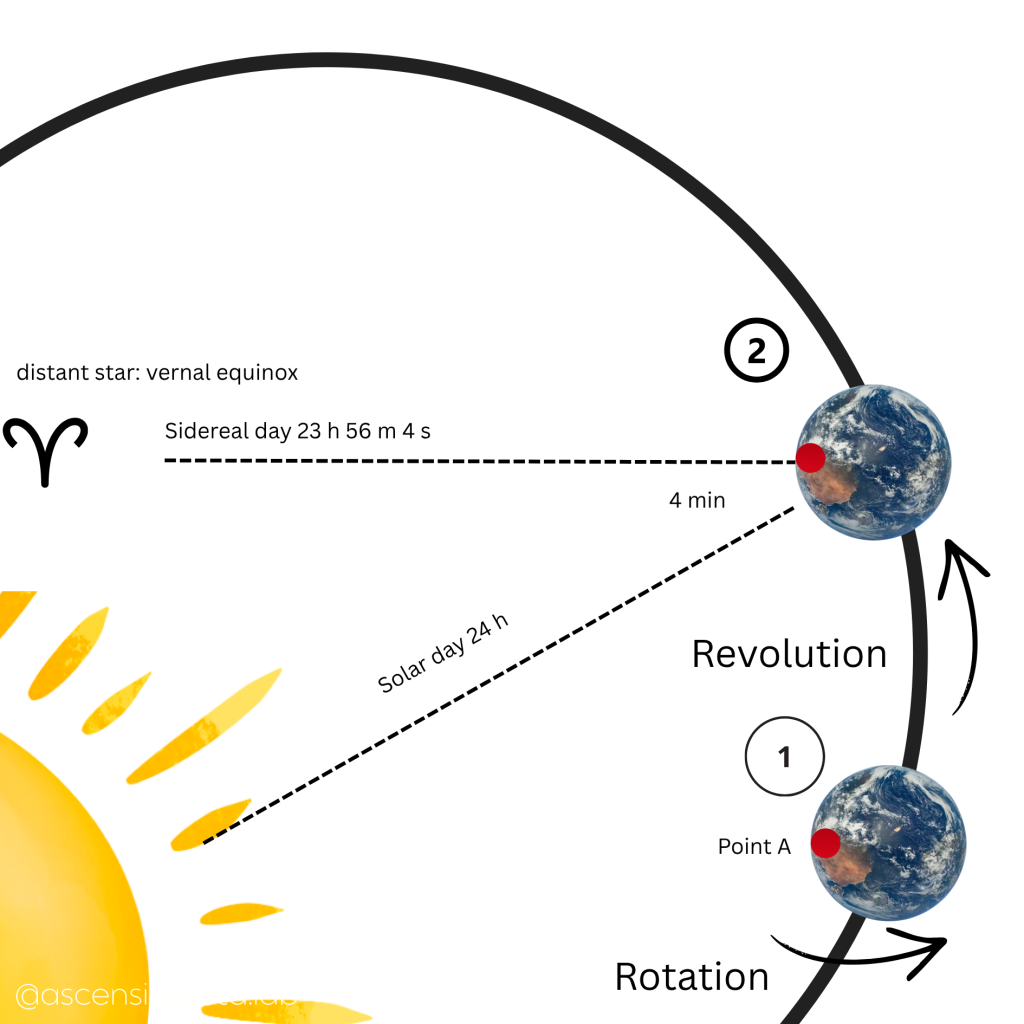
Earth actually has two different kinds of days, depending on which reference point in the sky we use. The first is the familiar solar day, shaped by Earth’s two motions: its rotation on its axis and its revolution around the Sun. But astronomers also use another definition called the sidereal day. This is the time it takes for Earth to complete one full 360° rotation—when a point on Earth returns exactly to the same direction relative to the distant stars, specifically the vernal equinox, which serves as a fixed reference point. As the illustration shows, this star-based day reveals Earth’s true rotational period, which is slightly shorter than the 24-hour solar day we experience.
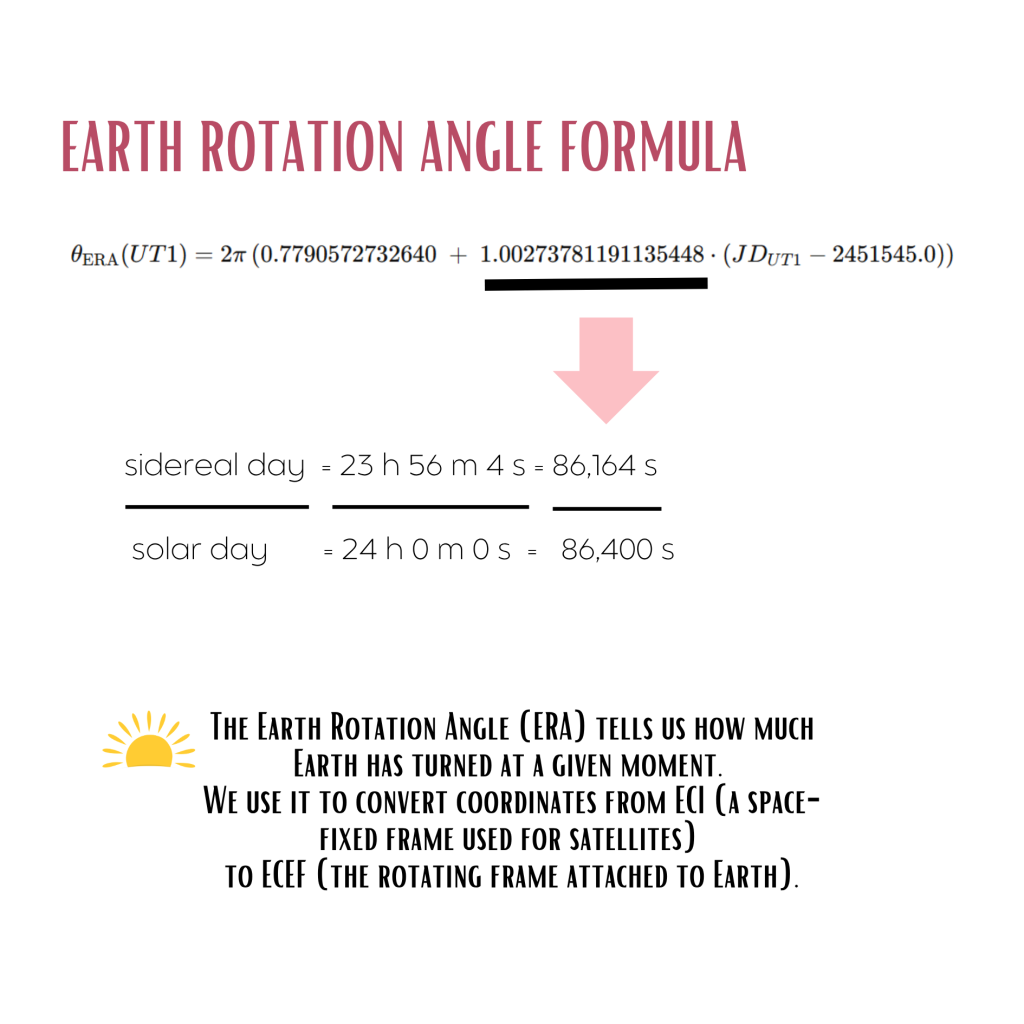
What is the sidereal day actually used for? In everyday human life, the solar day is the most intuitive and practical measure of time—it defines our 24-hour cycle of daylight and night. But in scientific fields that study Earth as a rotating body in space—astronomy, geodesy, orbital dynamics, and GNSS—the sidereal day becomes essential. These disciplines need a time scale that reflects Earth’s true rotational speed relative to distant stars, not relative to the Sun.
The key constant inside ERA comes from comparing Earth’s rotation relative to the stars versus the Sun: the sidereal day is 23 h 56 m 4 s (or 86,164 seconds), while a solar day is 86,400 seconds. Dividing these gives the factor 1.00273781191135448, which represents how much faster Earth rotates in sidereal time.
Sideral time reveals that our planet completes one true rotation earlier than our clocks suggest,uncovering a subtle but fascinating difference in how Earth keeps time.
Leave a Reply