
Precession and nutation are not just abstract motions. They are the reason we can connect the sky to the ground with precision.
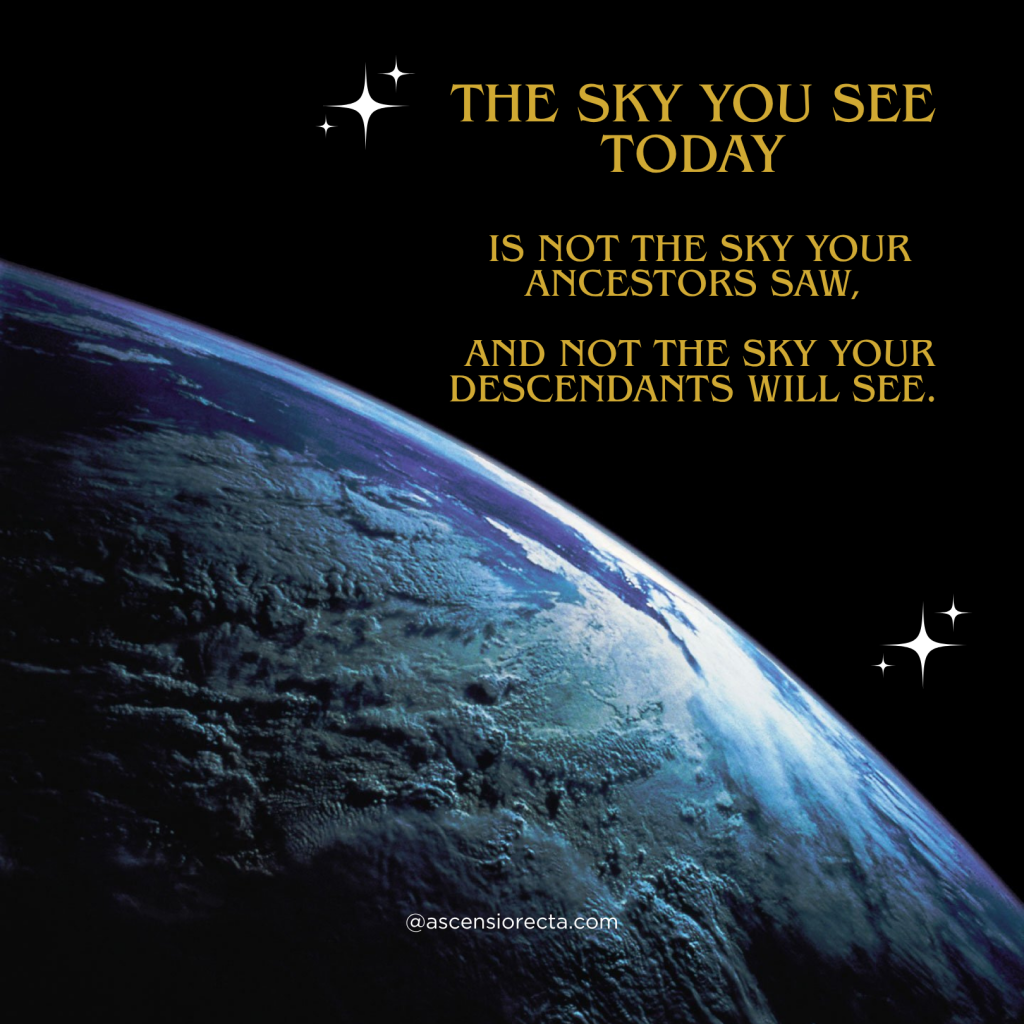
When we imagine Earth spinning, we often picture it as perfectly steady – a smooth sphere rotating without change. But in reality, Earth is more dynamic than it appears. Its axis is tilted by about 23.5°, giving us seasons. It is slighly bulged at the equator, not a perfect sphere. And most importantly, it doesn’t spin in a fixed dirrection forever – it slowly wobbles. The motion is constant and predictable, Its called Precession. Because of this slow wobble, the sky itself is not permanent.
This wobble arises from the gravitational influence of the Sun and Moon. Because Earth is slightly bulged at the equator, these forces create a torque that slowly shifts the direction of its rotation axis.
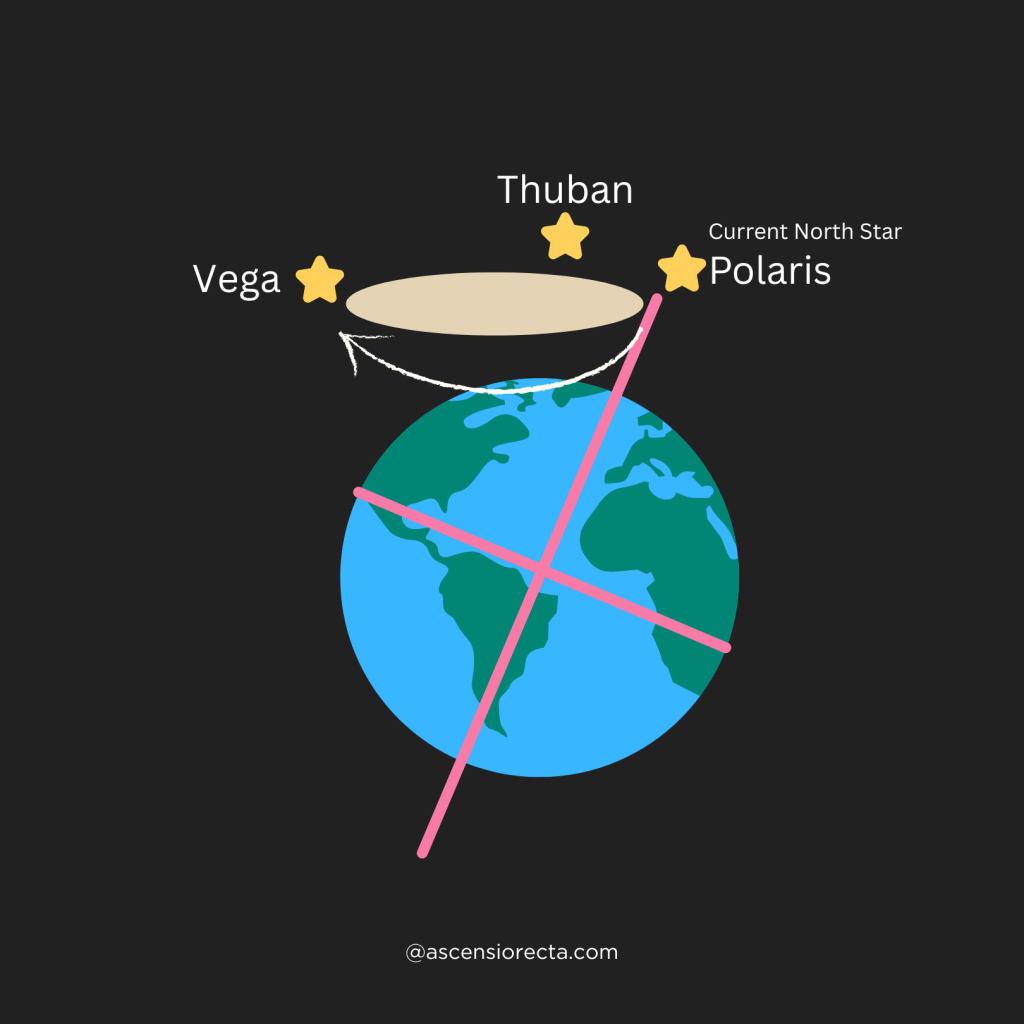
Right now, Earth’s axis points close to Polaris, which is why we call it the North Star. But this alignment is not permanent. Earth’s axis slowly moves, tracing a circular path in space. Over about 26,000 years, it completes one full cycle.
Because of this motion, the identitiy of the North Star changes overtime. Around 2600 BCE, when the ancient Egyptians were building the pyramids, the North Star was not Polaris – It was Thuban.
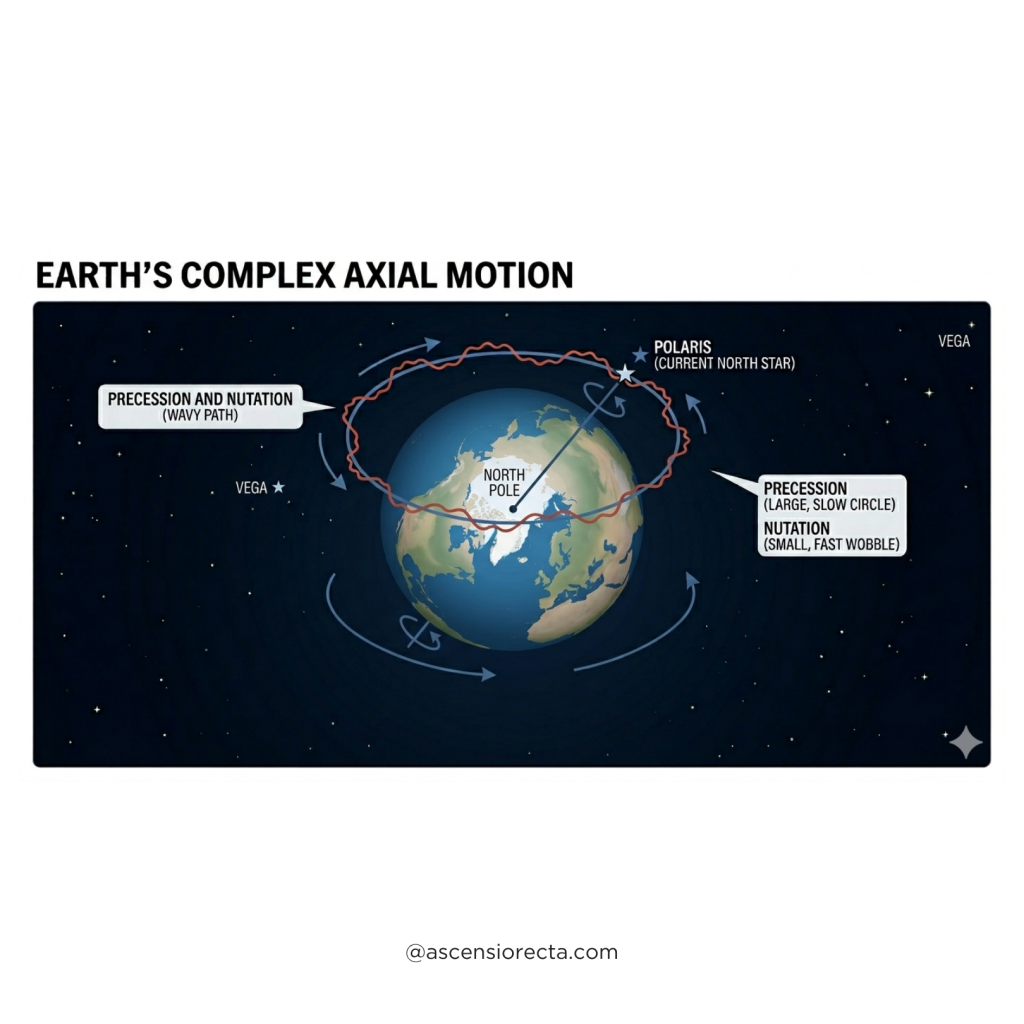
But Earth motion is not only about precession. There is also nutation – a smaller, more subtle movement layered on top of it. Nutation is a tiny oscillation, a gentle wave riding along that motion. It causes the axis to slighly nod back and forth over shorter periods.
Why do we need precession and nutation (Technically)?
Another important reason to understans precession and nutation is for precise calculations
Without accounting for precession and nutation: GNSS (Global Navigation System Satellite) would lose accuracy & ADCS (Attitude Determination and Control System) would be less reliable. In short, we wouldn’t know exactly where things are – either in space or on Earth.
When we convert coordinates frame from ECI (Earth-Centered Inertial) to ECEF (Earth-Center Earth-Fixed), we don’t rely on rotation alone (like sidereal time). We also need to account for how Earth’s axis is actually oriented at the moment. That’s where precession and nutation come in, so our calculations are not just approximate – but precise.
Reference:
[2] https://geodesy.science/glossary/cip-celestial-intermediate-pole/
[3] https://earthsky.org/brightest-stars/thuban-past-north-star/
[4] https://www.space.com/ancient-north-star-thuban-eclipses-companion-aas235.html
[5] https://mydarksky.org/2008/10/14/the-earths-wobble-precession/
Leave a Reply